Our Results:
High Pollution:
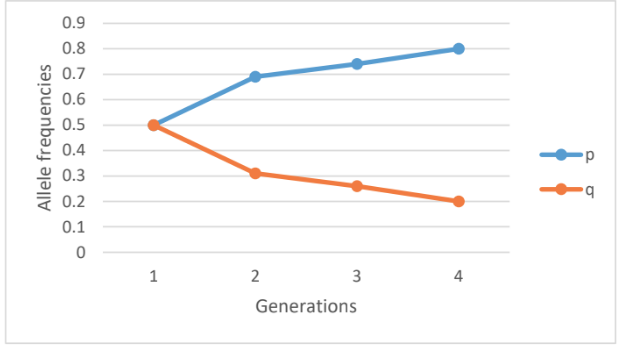
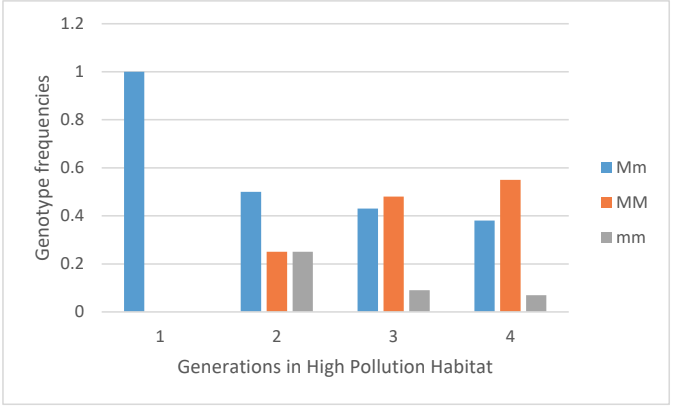
When there was “high pollution” (more black on the paper) the darker moths were able to survive while the number of white moths declined the more generations that were introduced.
Moderate Pollution:
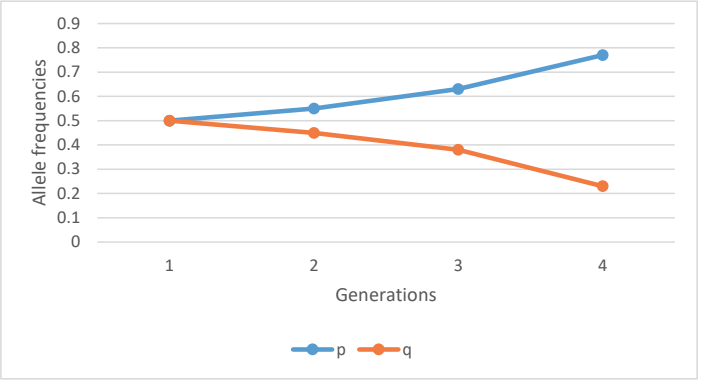
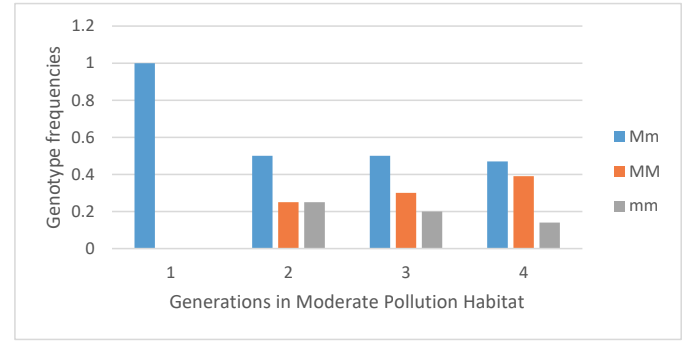
As far as the moderate pollution line graph, the dominate allele is increasing while the recessive allele is decreasing. This is similar to the higher pollution model, however it is at a more gradual rate.
Low Pollution:
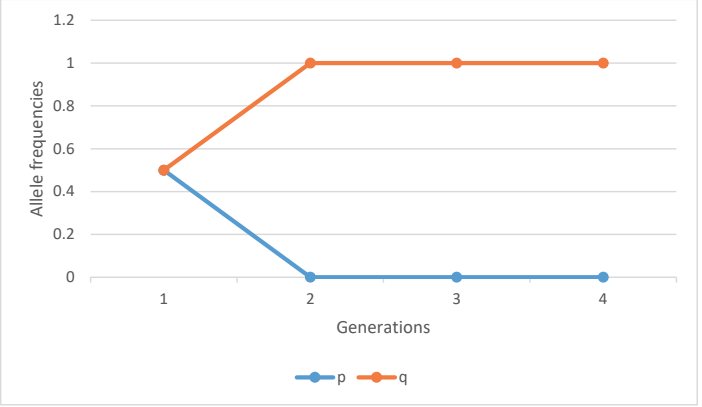
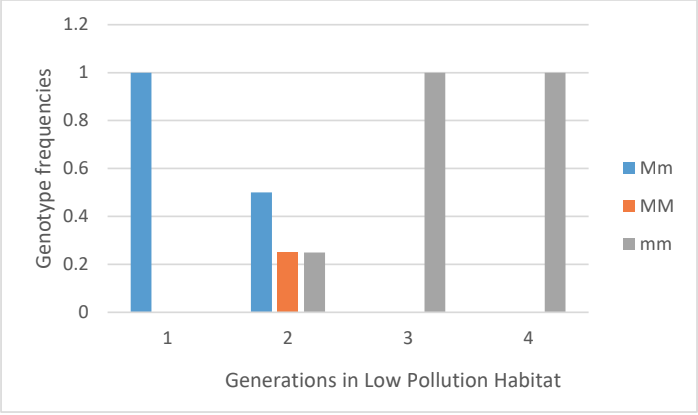
As far as a low pollution environment, the dominate allele that create the darker moth has gone extinct.
Conclusion:
In conclusion, the environment plays a huge role the survivability for the species. High pollution and moderate pollution allows the darker colored moths, with the phenotypes “MM” and “Mm” to blend into their surround. In these environments, the lighter colored moths with the phenotype “mm” have a harder time trying to avoid predators. However, in the low pollution environments, the lighter moths have the upper hand. They have a higher survival rate, while the darker moths result in extinction.
Peer Review
In the article, Selection and Gene Flow on a Diminishing Cline of Melanic Peppered Moths, the authors evaluate the most recent study on carbonaria Biston betularia. They found that the black species declined after legislation to improve air quality. However, in 2002, researchers found that this decline still exists, but is much smaller. The morph is not favored as far as landscape factors, however, there are high dispersal aids against genetic isolation. This new research has lead scientists to believe that it allows for new conclusions to be drawn involving gene frequency change in this species. It also has reinstated how multiple generations are required for this change to occur.
Review: A Man’s New Best Friend?
In the article, Man’s New Best Friend? A forgotten Russian experiment in fox domestication, Jason Goldman, the author, explores the history of the genetics in Communist Russia. Goldman uses the history of Lysenkoism to illustrate the importance of study genetics. Lysenkoism states that acquired characteristics cannot be genetically given to the offspring. However, after Russia’s change in political stance, Dmitri Belyaev is able to test the hypothesis that changes observed in domesticated animals is influenced by the selection of behavioral traits. Belyaev conducts an experiment by domesticating one-month-old silver foxes. The foxes where there bred after determining how tame they were through a test that evaluated their response to touch. The offspring were then evaluated by their responses to human interaction. The offspring acted kinder towards the researchers compared to wild silver foxes. Through generations of breeding, physical changes were also seen.
Sources:
Saccheri, I. J., Rousset, F., Watts, P. C., Brakefield, P. M., & Cook, L. M. (2008, October 21). Selection and gene flow on a diminishing cline of melanic peppered moths. Retrieved April 20, 2019, from https://www.ncbi.nlm.nih.gov/pmc/articles/PMC2571026/


