Dispersion:
Through this field study, we studied the dispersion of the plant species. Dispersion is the process of how an individual spread out in a population in a given area. The dispersion can be classified into three different categories, clumping, uniform, and random. Clumping dispersion is when the position of the organism depends on the distribution of resources, safety precautions, and/or mating locations. Uniform dispersion is the spacing of an organism across the area, this can be the result of interactions between other organisms. Competition would be an example of this interaction. Random dispersion is when the spatial position of an organism occurs without the influence of other individuals.
Paspalum dilatatum:
The amazing the about Paspalum dilatatum is its ability to adapt to its surroundings. For example, in the abstract of “Effects of Flooding and Drought on the Anatomy of Paspalum dilatatum”, the authors illustrate key constitutive and plastic anatomical traits that allow the plant species to survive in droughts or floods.
Constitutive anatomical traits:
There are high amounts of aerenchyma and sclerenchyma and a conspicuous endodermis. All the factors allow for the protection of the roots and leaf sheath. Aerenchyma will maintain aeration, sclerenchyma, and the endodermis will protect the stellar tissue.
Plastic anatomical traits:
Depending on the flooding or drought conditions, the plant is able to adapt. The flooding precautions that the plant take is decreasing the structures that allow water uptake. This includes gaining more aerenchymatous tissue in the roots and leaves. The plant also decreases the number of root hairs. During a drought, the plant decreases the size of the root metaxylem vessels and increases the number of root hairs. These precautions allow for the plant to conserve water, but also allow the most access to potential water uptake.
Our Interpretation:
When considering these factors in relation to our field study, it would explain how the plants are able to survive in multiple conditions. This means that even if the plants were in a location that didn’t get as much water as others, they would still be able to survive in these conditions, but the roots would be smaller. This could result in smaller clusters that are formed.
Our Field Research:
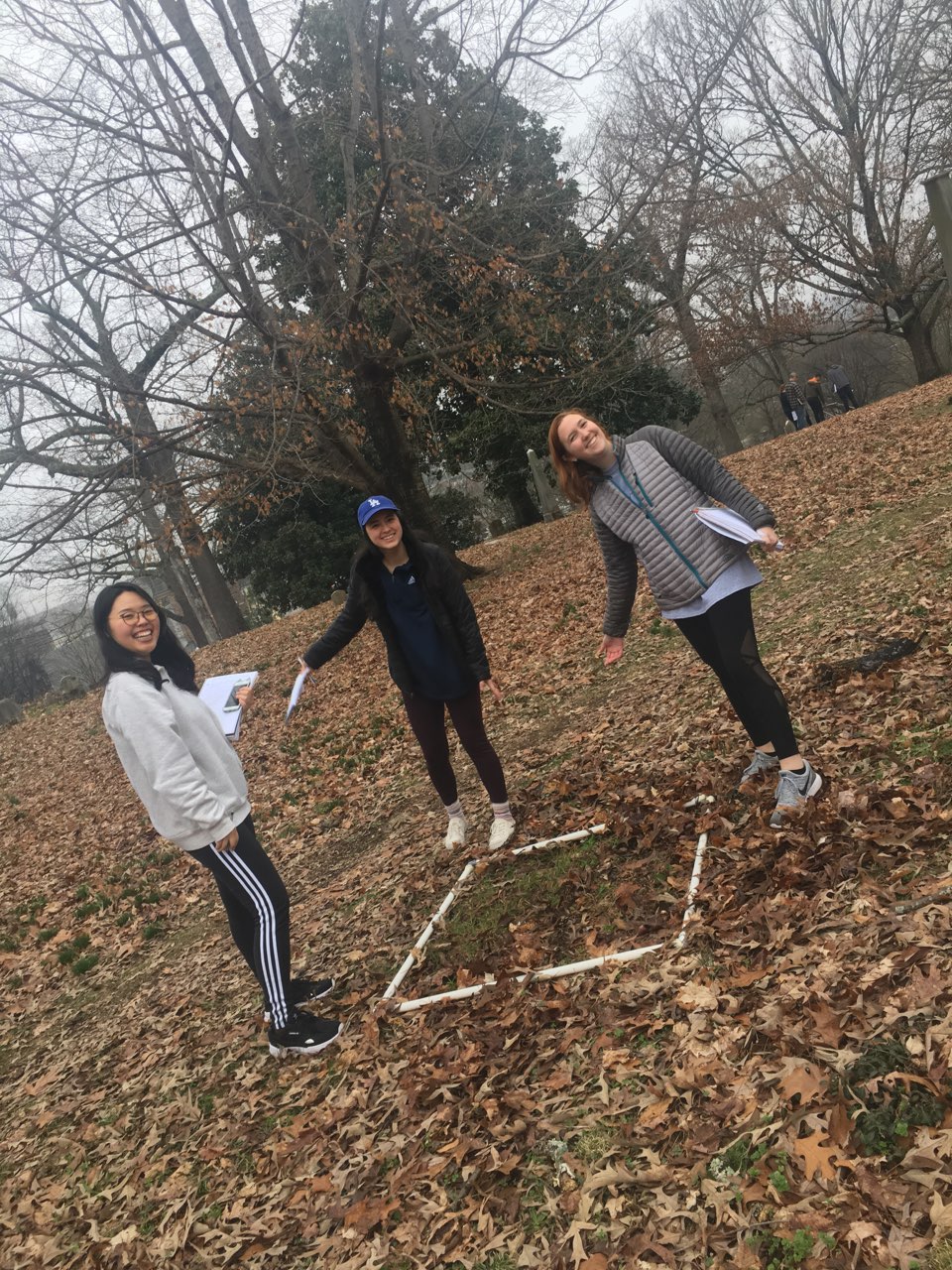
(Jisu (left), Veronica (middle), and Morgan (right) places down our quadrat) 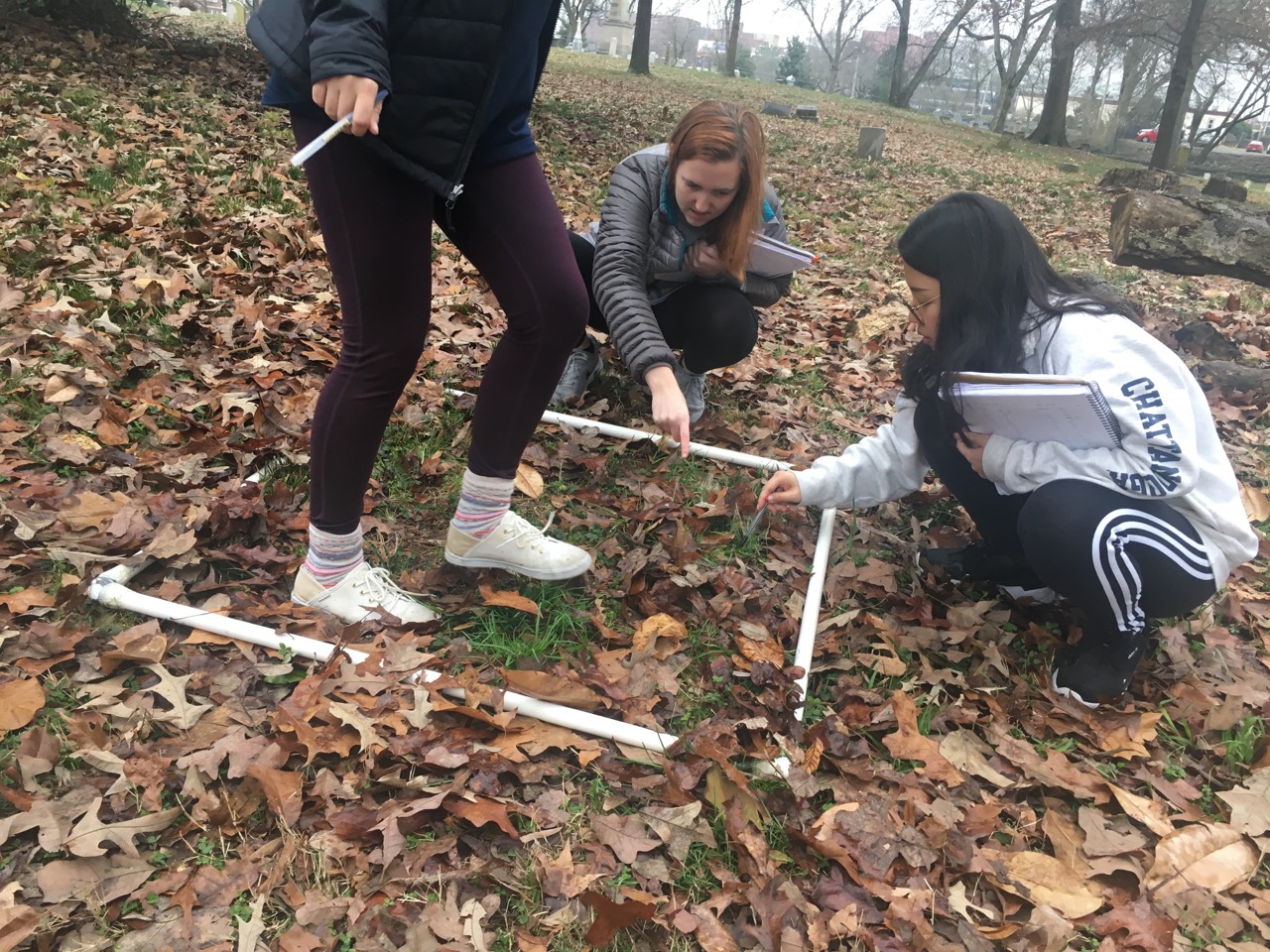
(Morgan and Jisu clearing leaves from the quadrat)
In our field study, we used one meter by one-meter square to set quadrat. We were supposed to set randomly select section of the Confederate Cemetry to observe and count the number of Paspalum dilatatums we saw. We took 10 different sample quadrat and found that our average density was 5.8 Paspalum dilatatums square meter. We notice that our largest number of the plants was in the wettest area of the cemetery, this leads us to believe that the plants could be dispersed by clumping dispersion.
Prediction:
Based on the readings and our data, I believe that when we evaluate the class data as a whole that we will find that Paspalum dilatatum’s dispersions are the clumping dispersion. Although the abstract of “Effects of Flooding and Drought on the Anatomy of Paspalum dilatatum” illustrates how these plants can survive in dryer conditions, we found the higher populations of the species in the areas that receive more water. This correlates with the definition of clumping dispersion. There would be more organisms there due to the fact that there is more access to the resources and the roots would be extending more.
Our Results:
Our group name for evaluation purposes was Mushroom. After running the chi-square and creating a graph for our data (as seen below), we are able to conclude that Paspalum dilatatum does exhibit signs of clumping due to the fact that the mean is smaller than the variance when the chi-square test was run.
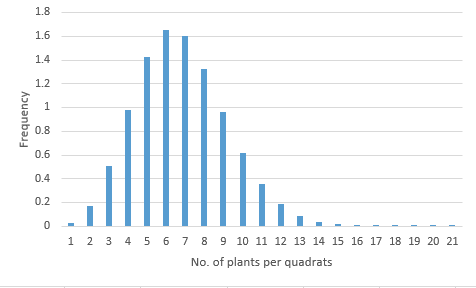
(Graph of Mushroom’s Data) 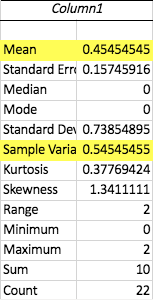
This also can be in the class data. By finding the class chi-square values, this furthers the support of the species distribution being defined as clumping.
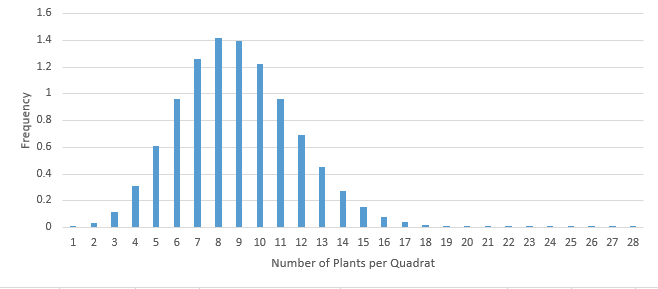
(Whole Class Data) 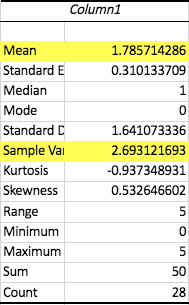
(Chi-square values for the Whole Class)
Spreading of Seeds:
The dispersion of the seeds also plays a role with distribution. P. dilatatum is spread multiple ways. These seeds can be spread by weather, animals, and human interference. The distance that seeds spread can be large depending on the animal caring them. For example, in the article by Erik Stokstad, he talks about how elephants can carry seeds for great distances. The same thing is for the P. dilatatum, but on a smaller scale.
Plants have an unexpected response to climate change:
This is an important article to read to understand the full effects of climate change on Earth’s population of plant species. Jennifer Balmer explains the science behind how climate change is creating a migration plant species. She exclaims as the temperature is rising plants are torn between moving downward for water accessibility and upward for cooler temperatures. Balmer states that “More than 60% of plants shifted their distributions downward, towards warmer, lower elevations.
Droughts and Paspalum dilatatum:
I believe that if P. dilatatum was put into increased drought conditions, the species would start to move upward to lower temperatures rather than downwards to more water availability. I make this claim solely on the fact that P. dilatatum has precautions to protect itself against drought-like conditions, but I am not sure about its ability to manage in higher temperatures.
Peer Review: Gibbula nivosa
Plants are not the only organism that can exhibit dispersion. A study conducted on the species Gibbula nivosa resulted in the indication of uniform dispersion. The researchers in the study where able to conclude from this analysis that the species was not social. G. nivosa is a top-shell sea snail located in the Maltese Islands. The density of the snails was “17.6 ± 25.0 SD individuals m−2” These snails were initially thought to have slightly clumped dispersion based off of a single quadlet grouping. However, when the species was evaluated as a whole, a uniform dispersion was apparent. The slight clumping dispersion was then dismissed as “patchiness in the environment.”
Relevance:
The research done on Gibbula nivosa is similar to the research methods that we did with Paspalum dilatatum, but on a larger scale. It is unique that the species was not found to be clumped distribution due to the fact that it is the most common type.
Source:
Evans, J. Borg, J.A. & Schembri, P.J. Mar Biol (2011) 158: 603. https:// doi-org.proxy.lib.utc.edu/10.1007/s00227-010-1584-4


