Personal Experience:
My roommate and I were walking back to our apartment after a night out this winter when on the way back we saw a rather medium size bird sitting outside our neighbor’s apartment door. We were not quite sure what to do, but both being animal lovers we felt obligated to do something. My roommate put a piece of bread next to the bird in hopes that it would at least the bird just need some food. Looking back at this experience, it seems very foolish. However, I was aware that the bird will shut down their body processes in an attempt to conserve energy when it is cold. This is just one way that animals can contribute to thermoregulation.
Thermoregulation:
Thermoregulation is important to all living things due to the fact that it allows an organism to use different processes to control their own body temperature based on the external temperature. The are two types of organisms that use thermoregulation. They are known as endotherms and ectotherms. Endotherms produce their own body heat through internal metabolic heat. Endotherms must maintain their heat through insulation which in result allows them to generally be bigger animals. However, this also means that endotherms will have a harder time cooling themselves off in warm weather. Ectotherms rely on external sources of energy to regulate body temperature. Ectotherms utilize processes like basking. Basking is when animals lay in direct sunlight to absorb heat.
The Lab:
General Lab:
The purpose of this lab was to recognize different factors that play a role in thermoregulation. Some examples of these factors were size, color, and amount of direct sunlight. My partner and I decide to use this opportunity to test how the amount of surface area contributed to the time it took for our animal to heat and cool down. We began our experiment by familiarizing ourselves with our equipment by running the experiment on practice cubes. The object is put in front of the heat lamp with a thermometer inside the cube to monitor the temperature. This temperature was checked every minute and the temperature was then recorded. The light was kept turned on until the temperature leveled off its highest point. After this, the light was then cut off to trigger the cooling process.
Using the same method in the introduction experiment, my partner and I chose to focus on body size with an emphasis on the body surface in birds. Our birds were each stuffed with four cotton balls, while both of the outsides of the birds were made with tin foil. Because most birds are endotherms, it was important to stuff the birds to accurately depict their insulation. My hypothesis was If we increase the amount of surface area during the study, then the subject’s temperature will be able to the fluctuate faster. I figured that if there was more surface area both times would be shortened by the larger ratio of the body surface in direct contact with the environment to the depth of the bird.
Individual Lab:
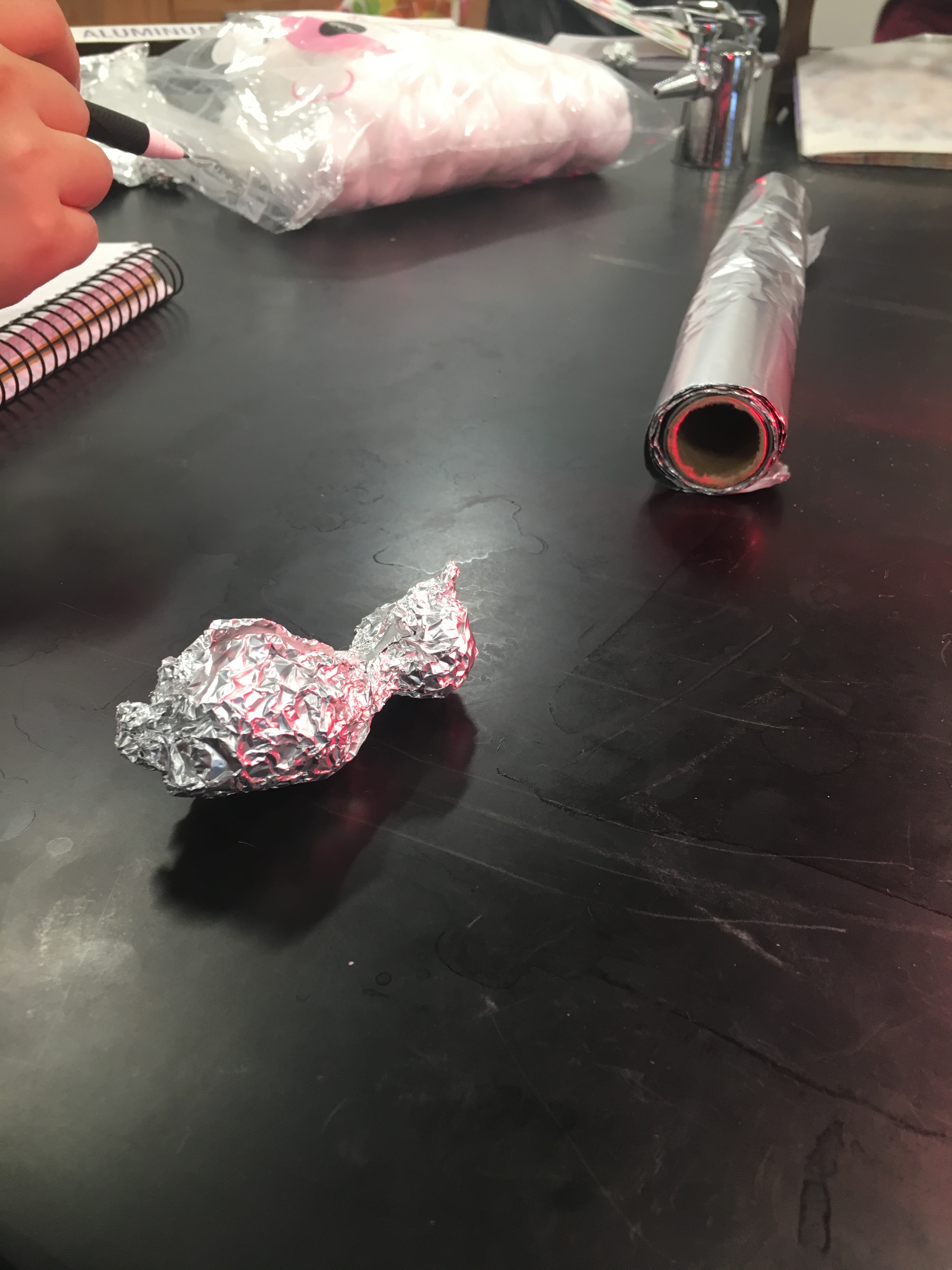
(Small Bird in away of heat lamp) 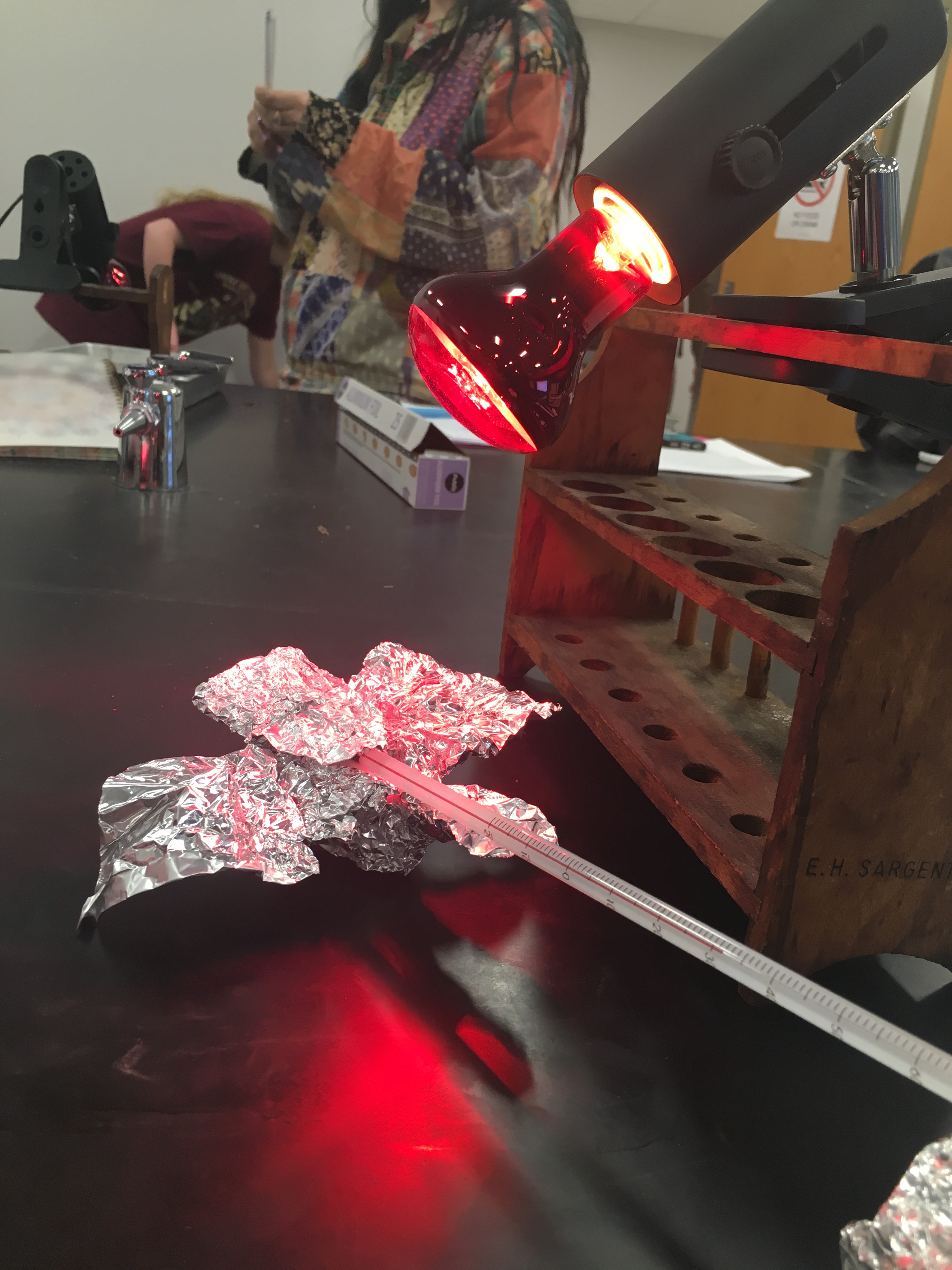
(Large Bird in front of heat lamp)
Results:
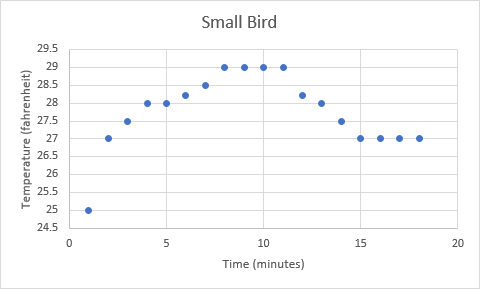
(Small Bird Scatter Plot: Temperature v.s. Time) 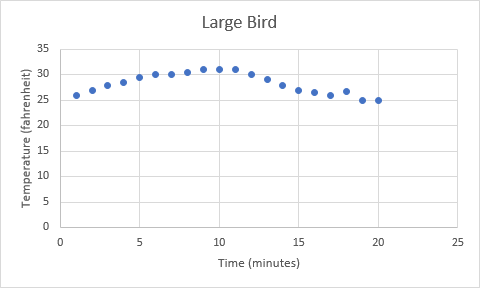
(Large Bird Scatter Plot: Temperature v.s. Time)
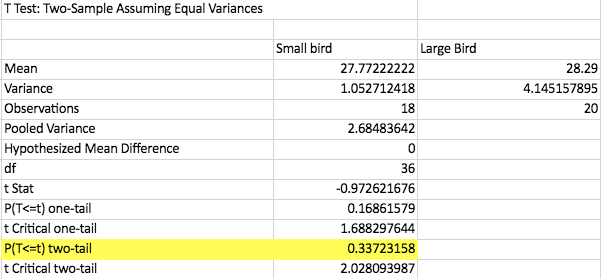
Based on the results, the hypothesis is rejected. Not only did the bigger bird take longer to heat, but also to cool down. The surface area did not figure out how I had originally believed it would. Because the smaller bird was able to heat up and cool down faster than the bird with more surface, in this situation the smaller bird would be able to adapt to the warmer climate change. Our p-value was 0.337, which is over the chosen alpha level at 0.05. This means that our data does not have statistical significance. The null hypothesis is supported, meaning that the surface area of “bird” has no effect on the cooling and heating periods of our experimental animal.
Errors:
There are a couple of factors that can affect the results of our experiment. For example, to completely compare these two birds, we should have checked to our controlled factors more carefully. The weight and the size of both bird should have been measured. The distance between the heat lamp and each bird should have been checked before every trial run. There also should have been more than two trial runs conducted to obtain an accurate t-test.
Science Daily:
Two studies were conducted in May and June of 2018. In the article “Monkeys Eat Fats and Carbs to Keep Warm”, Professor David Raubenheimer and Charles Perkins Centre conducted a study on the nutritional intake of Monkey in China’s Quinling mountains during the winter and compared them between the nutritional intake of that in spring. They found that the carb and fat intake double in winter compared to the spring months. They concluded that these animals knew and only consumed the nutrients that their bodies need for certain seasons. In conclusion, it mentions that Professor Raubenheimer is conducting multiple studies like this one to try and understand the motive behind obesity in the human species.
In contrast, the other studied is mentioned in the article “Huddling for Survival: Monkey’s with more Social Partners can Winter Better”. In this article, Dr. Bonaventura Majolo and Liz Campbell studied the social thermoregulation of wild Barbary macaques monkeys in Morocco. Social thermoregulation pertains to how the bonds that these monkeys have formed in their community and how that helps them to regulate their temperature. An example of this would be huddling, which these monkey as seen doing. In their results, it was found that the monkeys were more likely to spend more time grooming each other, in a huddling way when the temperature was lower and or there was higher precipitation.
Comparison:
These two articles depict different ways that animals use thermoregulation. One evaluates the social aspect while the other assesses the food intake. Both aspects are important to calculate due to the fact that climates are becoming more extreme over time. Thermoregulation is important to study in every aspect because it will be a key factor to look at the adaptation of species as this drastic change occurs in the environment.
Body Temperature:
In the article, “Body Temperature Regulation in Hot Environments”, A. P. Leventis Ornithological Research Institute in Nigeria conducted a study evaluating the effects of body mass on body temperature in small birds in hot environments. The researchers also focus on which birds went into hyperthermia. Hyperthermia is the process of the body shutting down to conserve energy and water in the body. This idea was mentioned early in the “Personal experience” section of today’s blog post. They concluded that only two of the species being studied went into the state of hyperthermia in this environment. (Nilsson et al.,2016)
This although in this study the researchers continued their study to direct sunlight, shade, and hyperthermic processes, they also look at the mass of the birds. This relates back to our study of focusing on the size of the bird in direct sunlight. During our study, we found that the smaller the surface area, the easier for the bird to cool and heat.
In Conclusion:
The study of thermoregulation is important due to the fact that the climate around the world is becoming more extreme. It affects human’s as well as animals. It is dire that humans look to thermoregulation studies to seeing changes in the environment and the adaptations that are following.
Sources:
Nilsson, J., Molokwu, M. N., & Olsson, O. (2016). Body temperature regulation in hot environments. PLoS One, 11(8) doi:http://dx.doi.org.proxy.lib.utc.edu/10.1371/journal.pone.0161481


