(Photograph taken of Lulu in 2016 by Elisabeth Oliver)
Everyone knows the videos of cats being scared by cucumbers and the endless accounts of cats being “sassy” or “grumpy” with their owns. And who can forget picking up the first dead animal present your cat has left you lying in the middle of the floor? But not everyone is aware of the threat that these lovable but yet hateable creatures create for our surrounding ecosystems due to their home range.
Home Range:
Every animal has a home range. A home range is a physical area that an animal covers when conducting daily activities. Home ranges can vary due to factors of food and mating availability or predator location. Scientists have developed radiotelemetry has a way to monitor an animal’s movement by attaching a signal emitting transmitter on to the animal. The transmitter then signals to a receiver where scientists can gain access to the information being transmitted.
Cats’ Home Range:
Cats are known to be one of the biggest predators. This can be seen especially when evaluating the predation they contribute to the small bird population. Because cats are such natural predators, the more cats are allowed free range, the more small birds and animal populations will decrease. According to the resource dispersion hypothesis, the home range will increase when resources are limited. Therefore, once a cat or cats have exhausted resource in one area, their home range will continue to grow and have impacts on the surrounding ecosystem.
Result:
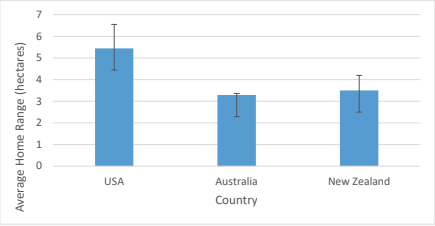
(Graph illustrating the averages of Home Range per Country)
Through the evaluation of a sample of forty-five cats and the bar graph above, we were able to determine that the cats in the United State have a larger home range than Australia and New Zealand. During the data gathering from the site MoveBank, I made sure to compare urban cats to more rural cats and found that rural cats seemed to have general larger home ranges. However, there were the exceptions for both types of cat.
Discussion:
The main question to ask concerning the research is why are cat avoid certain places and returning to others. Some biotic factor that can be evaluated, as stated before, are mating and food availability and the avoidance of predators. Some abiotic factors would fall more along the line of geographical inhibitors. For example, streams and creeks that cats couldn’t cross. Busy streets would also be another one.
In the future:
Now that we are provided with the information to see a pattern, how can we fix this ecological problem that cats are creating for the communities? One way would be to create safe environment for the local wildlife species, specifically looking at birds. For instance, bird house can be set around park were cats cannot break into. This would protect bird species populations with out bring harm to the cats home range.
The Cats of Northwest Georgia:
A study conducted in the Northwest of Georgia study whether the change in the home range of domesticated cats varied based upon seasons and night time v.s. Day time, and the predation of the cats. The study focused on seven cats on a free-range farm. The study showed that there was no effect from seasonal variation, however males cats showed to have a larger home range both at night and during the day, than their female counterparts. Throughout the study, researchers would also scat the cats. There were a total of 210 scats during the study. Through these scats, researches were able to discover that of the 158 scats that contained hair, 86 scats contained hair from the felines’ prey. Final, the studied conclude by making the claim that “Large home ranges of free-ranging cats could negatively impact native wildlife.”
Relation to Our data:
While re-evaluating the data, I notice that it seems that sex also contributes to the increase of the home range. Although a female cat held the largest home range value, overall males did have a general higher home range average. This could possibly be contributed with males seeking a mate rather than the females.
Sources:
Kitts-Morgan, S., Caires, K. C., Bohannon, L. A., Parsons, E. I., & Hilburn, K. A. (2015). Free-ranging farm cats: Home range size and predation on a livestock unit in northwest georgia. PLoS One, 10(4) doi:http://dx.doi.org.proxy.lib.utc.edu/10.1371/journal.pone.0120513


